The True Cost Savings of Using Qualified Loft Insulation Installers
For numerous households, the loft represents the largest contributor to heat loss, with as much as a quarter of warmth dissipating through an uninsulated roof. Enhancing or installing loft insulation stands out as a highly economical method to decrease energy expenses, boost comfort levels, and minimise carbon emissions. While some homeowners may contemplate a do-it-yourself approach, there are strong financial incentives to hire professional loft insulation installers from the beginning.
Choosing qualified loft insulation installers goes beyond mere convenience; it is essential for guaranteeing that the work is executed properly, safely, and to a standard that maximises the savings promised by the materials. This article outlines the practical aspects of saving money through professionally installed loft insulation, covering installation quality, longevity, payback periods, and access to support schemes.
Loft insulation plays a crucial role in lowering energy bills. By creating a barrier that prevents heat from escaping, it helps maintain a comfortable temperature in the home. This means that heating systems don’t have to work as hard, leading to reduced energy consumption and, consequently, lower utility costs. Properly installed loft insulation can significantly enhance energy efficiency, making it a wise investment for homeowners looking to save money.
Loft insulation functions by establishing a thermal barrier that inhibits the transfer of heat from the living areas beneath to the chilly roof space above. During winter, this indicates that your heating system does not need to exert as much effort to keep a comfortable temperature. During the summer, it can assist in maintaining a cooler home by minimising heat gain through the roof. The outcome is reduced energy usage for space heating and, in certain instances, for cooling too.
The amount saved varies based on the type of property, the current insulation levels, and the heating system in place. In a typical gas-heated home in Great Britain, upgrading from no loft insulation to the recommended depth can result in savings of approximately two hundred to nearly four hundred pounds annually on energy bills, with detached homes experiencing the most significant absolute savings. Even upgrading from an older, thinner layer to the current recommended standard can yield significant annual reductions.
Throughout the lifespan of the insulation, which can extend for decades when installed correctly, these yearly savings build up to a significant amount. A single investment in professional loft insulation installers results in years of decreased costs, with the initial expense frequently recouped within a few heating seasons.
Understanding the significance of professional installation can lead to substantial savings. When experts handle the setup, it ensures that everything is done correctly, minimising the risk of costly mistakes. Additionally, proper installation can enhance the efficiency and longevity of the system, ultimately resulting in lower maintenance costs and energy bills. Investing in professional services can prove to be a wise financial decision in the long run.
The theoretical savings from loft insulation rely on the assumption that the material is installed properly, ensuring consistent depth, complete coverage, and the absence of gaps or compression. In reality, accomplishing this in an actual loft with obstacles like water tanks, chimneys, electrical cables, and tricky eaves proves to be more difficult than it seems. Professional loft insulation installers possess the expertise to manage these intricacies, ensuring that no weak points remain where heat can escape.
A frequent error in DIY projects is compressing insulation around obstacles or neglecting to insulate gaps behind pipes and along the edges of the loft floor. Compression diminishes the material’s thickness, consequently affecting its thermal performance, while gaps form thermal bridges that compromise the entire installation. Experienced loft insulation installers possess the expertise to accurately cut and fit materials, maintain consistent depth throughout the entire space, and ensure that proper ventilation is upheld to prevent condensation issues.
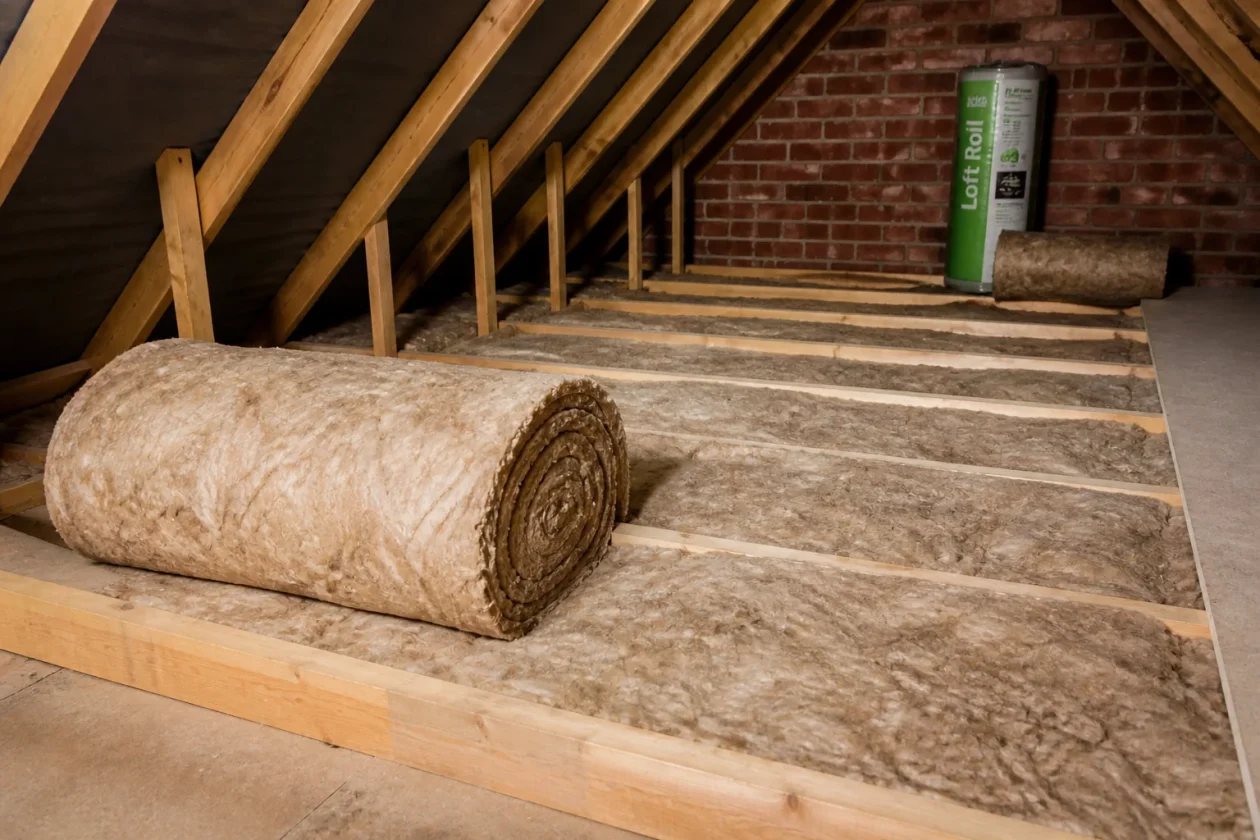
Professional loft insulation installers also come equipped with the necessary tools and materials. For larger or irregular lofts, blown or loose-fill insulation might be more appropriate than rolls; however, it necessitates specialised blowing equipment and technique to ensure an even layer. Similarly, certain roof constructions, such as flat roofs or rooms-in-the-roof, require tailored solutions that exceed basic blanket insulation. Hiring qualified loft insulation installers guarantees that the appropriate system is selected and installed according to manufacturer and building standards, safeguarding both performance and warranty.
Durability, upkeep, and cost savings
Saving money through loft insulation involves more than just the immediate decrease in bills; it also encompasses the prevention of future expenses resulting from inadequate installation. Improperly installed insulation can lead to moisture retention, hinder airflow, and result in dampness, mould, or timber deterioration within the roof structure. Addressing these issues can incur significant costs and might necessitate the partial or complete removal of the insulation, thereby eliminating any initial savings. Professional loft insulation installers possess the expertise to evaluate ventilation, vapour control, and moisture risk, thereby minimising the chances of these issues occurring.
Professional installation of high quality typically endures longer without settling, sagging, or becoming disturbed. When insulation stays in position and preserves its intended thickness, its thermal performance is upheld consistently over the years. This longevity prolongs the payback period to your advantage, as the identical initial investment continues to yield savings for many years. Conversely, a poorly executed DIY project might require correction or redoing within a few years, ultimately doubling the expense and postponing any potential benefits.
Additionally, it is important to take into account the indirect savings. A properly insulated loft enhances the warmth and comfort of the entire house, which may lessen the urge to increase the thermostat setting. Improving the property’s Energy Performance Certificate rating can also enhance its marketability and value if you choose to sell. Although these benefits may be more challenging to quantify accurately, they contribute significantly to the overall financial rationale for opting for professional loft insulation installers instead of taking shortcuts.
Payback periods and cost-effectiveness
The initial expense of professional loft insulation depends on factors such as property size, accessibility, and the type of system employed. However, for a standard three-bedroom semi-detached home, typical costs range from approximately seven hundred to just over one thousand pounds. Detached properties with more spacious loft areas typically come at a higher price, whereas smaller terraced homes are generally more affordable. Even at the upper limit of this range, the payback period is frequently brief when compared to typical home improvements.
With representative savings, a detached home that saves approximately three hundred to four hundred pounds annually on energy bills could recover the cost of a professional installation, which ranges from one thousand to one thousand two hundred pounds, in about three to four years. A semi-detached or terraced home may have slightly lower absolute savings and installation costs, yet can experience comparable payback times. Following this timeframe, the insulation consistently provides annual savings virtually without cost, year after year.
Considering the increase in energy prices, the return on investment can occur even more rapidly. As the cost per kilowatt hour of gas and electricity rises, every unit of heat conserved gains in value, reducing the duration required for the insulation to recoup its expenses. Professional loft insulation installers can offer customised estimates based on your existing bills, property type, and intended insulation depth, assisting you in comprehending the potential return on investment prior to making a commitment.
Access to programs, guarantees, and reassurance
Another financial benefit of employing professional loft insulation installers is the access to support schemes and favourable tax treatment that may not be available to those who choose to do it themselves. Certain government or utility-backed initiatives necessitate installation by accredited contractors in order to be eligible for grants, subsidies, or zero-rated value added tax. These can greatly lower the net expense for the homeowner, enhancing the overall financial viability of the project.
Professional loft insulation installers usually offer guarantees or warranties covering both materials and workmanship. If an issue arises, you have a defined path for resolution without shouldering the entire cost yourself. This differs from a self-installed system, where any faults, underperformance, or damage are solely your responsibility to address. For numerous households, the blend of lower initial expenses via schemes and the assurance provided by warranties renders professional installation the more financially sensible option.
Ultimately, there exists the significance of time and risk. Working in a loft can be physically demanding and may present hazards, including risks from falls, exposed timbers, electrical cables, and insulation materials that can irritate the skin and lungs. Professional loft insulation installers possess the appropriate safety equipment and are skilled in working effectively in tight, challenging areas. By steering clear of injury, minimising wasted time, and eliminating the necessity to buy or rent specialised equipment, you enhance the cost-effectiveness of pursuing a professional path.
Conclusion
Investing in professionally installed loft insulation offers benefits that extend beyond the noticeable decrease in energy bills. It focuses on guaranteeing that the insulation functions as designed, endures for many years, prevents expensive repair work, and meets the criteria for any potential financial assistance. By hiring qualified loft insulation installers, homeowners can fully reap the benefits of this measure, with payback periods often spanning just a few years and savings that persist long after the initial investment has been recouped.